Monday, June 7, 2010

Please Support my Campaign for Solarthon 2010

Solarthon 2010

Hi Everyone! On July 31st, I will be participating in an event called Solarthon 2010, where teams of volunteers from the San Francisco Bay Area will be installing solar photovoltaic systems in an Oakland community development with low-income families. The event is a fundraising block party that is sponsored by an organization called GRID Alternatives, a local non-profit organization that is dedicated to empowering communities in need with renewable energy and energy efficiency services, equipment, and training. This one-day event will help to raise money for community solar projects and bring energy savings to low-income families who need it the most.

I am incredibly passionate about this cause for several reasons. First, I believe that solar energy can be a powerful social policy tool by reducing utility bills, contributing to a healthier and cleaner local environment, and functioning as a source of community building and empowerment -- all of which have important effects on overall quality of life. Second, by training local individuals to design and install solar systems, this project will have powerful effects on the local economy by equipping individuals with the skills and experience necessary to enter the emerging solar industry. Finally, solar power will have long-lasting effects on the global environment, as we begin to transition away from carbon-intensive fossil fuels toward clean, renewable energy sources.

For these reasons, I am thrilled to be participating in Solarthon 2010, where I'll be working directly alongside low-income families to install solar systems on their homes, which will save each family over $16,000 in energy costs over the expected lifetime of the system.

Please join me in this project and sponsor my efforts by making a tax-deductible donation to GRID Alternatives! My personal fundraising goal is $1000, which will go a long way toward reducing energy costs for a family in need. Please help me to achieve my goal by visiting the following link: www.firstgiving.com/emilycwood

For more information about this event, please visit: www.solarthon.org.

For more information about GRID Alternatives, please visit: www.gridalternatives.org.

Thanks so much for your support!

Wednesday, June 2, 2010

Cafe Gratitude's Be Love Farm


This past week, I organized a field trip down to the Be Love Farm in Pleasant Valley, owned and operated by Matthew and Terces Engelhart, Founders of the Café Gratitude restaurant chain in the San Francisco Bay Area. Matthew and Terces are trailblazers in the American sustainable food movement, so it was an amazing privilege to be welcomed into their home to learn more about their philosophy and business model. In exchange for a gorgeous lunch of home-made tortillas with various beans and greens from their garden, we spent the day helping to grow organic fruits and nuts that supply the bulk of their restaurants in the Bay Area.

Cafe Gratitude's mission statement reflects a business style that is rooted in a deep connection to the community and land that provides the energy to grow their food:

"Café Gratitude is our expression of a world of plenty. Our food and people are a celebration of our aliveness. We select the finest organic ingredients to honor the earth and ourselves, as we are one and the same. We support local farmers, sustainable agriculture and environmentally friendly products. Our food is prepared with love. We invite you to step inside and enjoy being someone that chooses: loving your life, adoring yourself, accepting the world, being generous and grateful every day, and experiencing being provided for. Have fun and enjoy being nourished. Welcome to Café Gratitude!"

To learn more about Café Gratitude, please click here.

Friday, May 21, 2010

Agriculture Day in Willits


One of the best parts of my job is getting to teach little kids about sustainable living, and (more often than not) learning from them about what it means to live sustainably. Over the past two months, I've met dozens of 8-10 year olds who've taught me all about what it means to live off the grid, to build natural structures, to raise animals and grow vegetables organically... and the list goes on. Needless to say, it is a constant source of inspiration in my life these days.

Yesterday, we had the privilege of participating in Agriculture Day in the town of Willits, where we taught 400 Grade 2-4 students how to make adobe bricks using natural materials from the earth and how to bake cookies using a solar oven. Between hands-on sessions, I met two 9-year old beekeepers named John and Clay, who were demonstrating how to make honey from their backyard hive. Watching little kids teaching other kids about the benefits of homesteading was pretty amazing.

Tuesday, May 11, 2010

Thursday, May 6, 2010

Urban Homesteading: How to Raise Backyard Goats


Urban homesteading is super trendy right now in the Bay Area, where just about everyone seems to have a few backyard chickens or goats these days. Since we had the chicken part down pat since Day One, we decided to adopt two baby goats last week to go through the process of raising our own meat in a sustainable manner. Not surprisingly, it has generated a bit of controversy among the organization's vegetarian donor base, but we strongly believe that if we eat it, we should know what's involved in raising and processing it. So we built a large pen under one of our solar arrays, picked up some goat feed, and adopted two little bucklings of about six weeks old.

In addition to being a great source of meat, raising a small goat herd can also be a powerful method for landscape management, as goat grazing controls a lot of unwanted weed species like poison oak, which is pervasive in Northern California at this time of year. Another benefit of raising goats is all of the fantastic by-products that you can make with their milk and whey, such as cheese, yogourt, ice cream, and soap!

For more information on the benefits of raising backyard goats, please visit www.supergoat.org.

Tuesday, April 27, 2010

How to Design and Install Grid-Tied Solar Systems


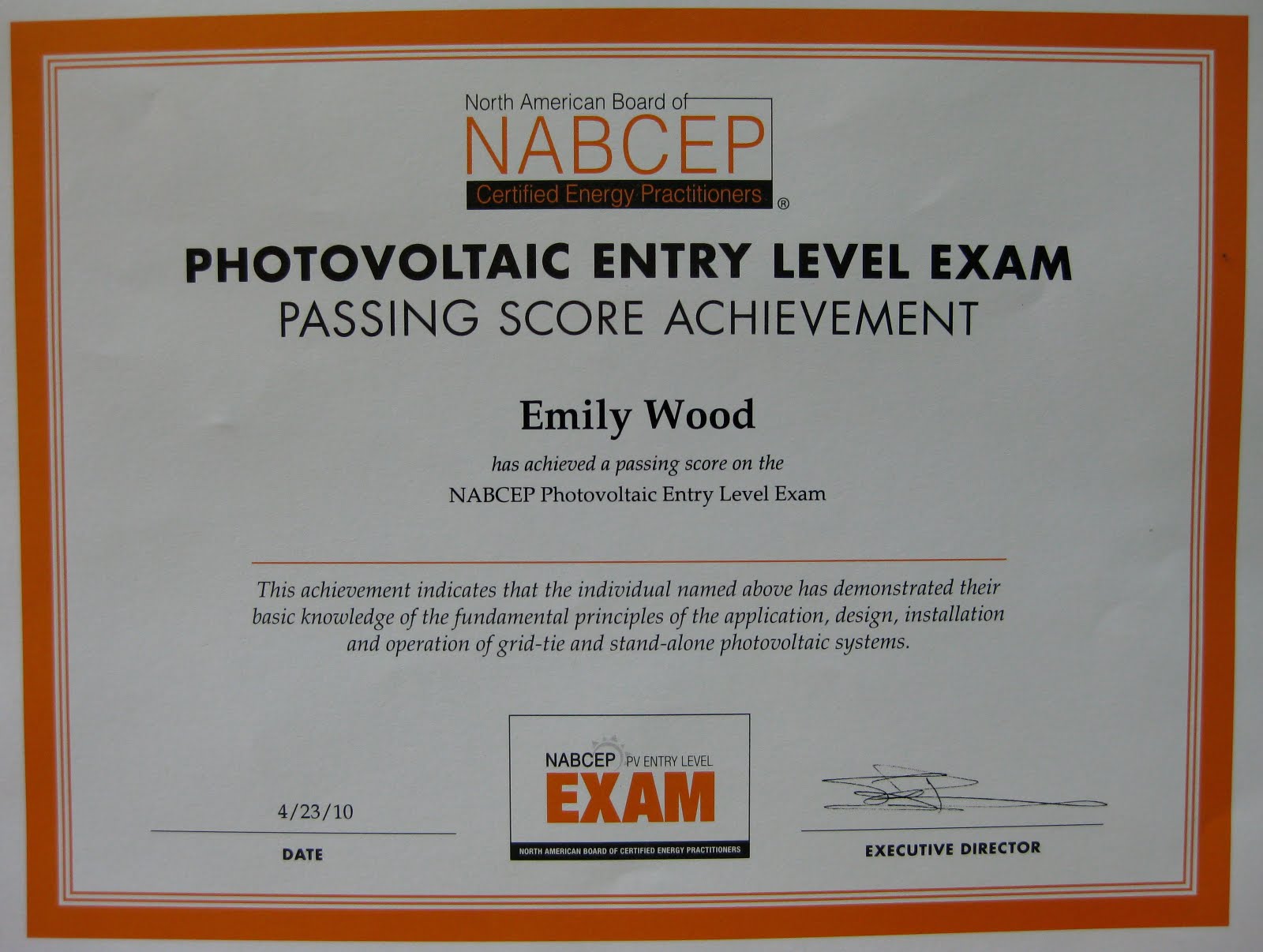
To complement the off-grid course I took last month, I spent all of last week in an intensive 40-hour solar photovoltaic design and installation workshop, focused primarily on how to design and install residential and commercial grid-connected solar pv systems. The course was designed to prepare students to sit for the NABCEP (North American Board of Certified Energy Practitioners) Entry Level Exam, which I took on the final day of the course. Through in-class demonstration and hands-on practice, I was able to learn the basics of pv system sizing and wiring; racking and mounting techniques; installing/connecting inverters, charge controllers, meters, and safety disconnects; ground fault protection; and battery sizing. It was great to finally learn some tech talk and get my hands dirty with an actual rooftop solar installation!

Like the off-grid course, the highlight of the week was getting to know the 28 individuals who traveled from across the country and world to do the workshop:

Manuel from Aruba, who plans to start a small solar business on his island community; Mario from Miami, who wants to add solar installation services to his clean tech company and expand its presence across the country; Oliver from Ecuador, who hopes to bring solar electricity to a local indigenous group; and finally Justin and Brian, two brothers from Oregon who are the first men in their family to defect from the logging industry to follow a new career path.

p.s. For my technically-inclined friends, the other highlight of the workshop was undoubtedly when I was the first in the class to calculate the AC power output of a polycrystalline solar module by multiplying STC wattage x irradiance factor x derate factors... all with a Grade 11 math education! If I could do it, anyone can.